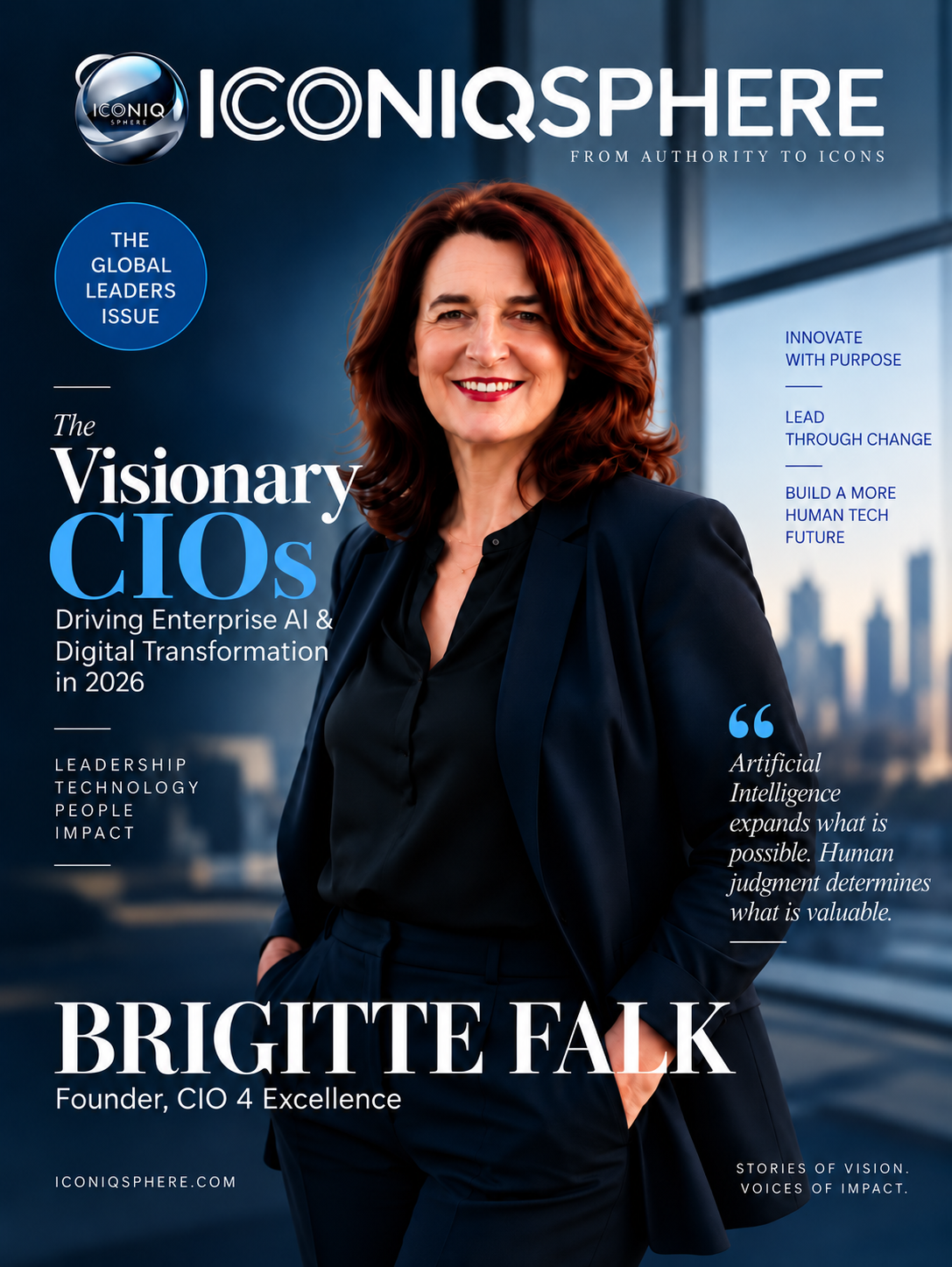
The Visionary CIO Driving Enterprise AI & Digital Transformation in 2026
Brigitte Falk
Managing Director | CIO 4 Excellence
Issue Profiles
 01
Tushar Cairae: Building Technology Around Business Outcomes
Chief Information Officer & Founder, Horizon Hive Technology LLC
Tushar Cairae, Founder and Managing Director of Horizon Hive Technology, brings the discipline of mission-critical aviation to enterprise transformation, championing resilient technology, practical AI, and a philosophy that measures innovation by the business value it creates.
Read profile 02
Gwen Swan: Building Trust into the Architecture of Intelligent Systems
Founder & CIO, Qaeon.io
Gwen Swan, Founder and CIO of Qaeon, is exploring the future of trustworthy enterprise AI through sovereign intelligence, cybersecurity, post-quantum security, and responsible governance. Her vision focuses on building intelligent systems where security, accountability, and human oversight are embedded by design.
Read profile 03
Kenneth Kicia: Turning Enterprise AI into Measurable Transformation
Chief Information Officer, Florida Department of Corrections
Kenneth Kicia, P.E., Chief Information Officer at the Florida Department of Corrections, is leading enterprise-wide modernization through responsible AI, cloud transformation, and data innovation. Overseeing a $200 million technology portfolio and more than 350 IT professionals, he is turning complex technology strategies into measurable organizational outcomes.
Read profile 04
Tiziano Andreoli: Making Technology a Business Language
Board Member | Chief of Editorial Commettee, CIO Club Italia
Tiziano Andreoli, independent IT advisor and CIO Club Italia board member, champions people-first technology leadership. His approach connects IT governance, cybersecurity, responsible AI adoption and business priorities to simplify complex decisions and deliver measurable organisational value.
Read profileThe Visionary CIO Driving Enterprise AI & Digital Transformation in 2026
Brigitte Falk brings three decades of leadership experience across SAP, global CIO roles, board advisory, and CIO 4 Excellence helping executives navigate digital transformation, AI, and complexity through clearer thinking and better decisions.
Brigitte Falk: Enabling Better Executive Decisions in an Era of Digital Transformation
Technology has never been more powerful. Organizations can access vast amounts of data, deploy Artificial Intelligence at unprecedented speed, and invest in platforms capable of transforming entire business functions. Yet despite these advances, many of the most important questions facing executive teams remain remarkably unchanged.
Where should we invest? Which opportunities truly matter? How do we turn innovation into lasting value?
And perhaps most importantly, how do we make the right decisions when the future is uncertain? For Brigitte Falk, these questions have defined more than three decades of leadership. Her career has taken her from SAP to global Chief Information Officer roles, board advisory positions, and ultimately to founding CIO 4 Excellence. Across industries, technologies, and periods of transformation, she has observed a consistent pattern: organizations rarely struggle because they lack technology. More often, they struggle because clarity becomes harder to achieve as choices multiply.
Curiosity as the Compass
Brigitte often reflects on her career with a sense of gratitude and perspective. While many assume her professional journey was carefully planned, she reports the defining force behind every chapter was curiosity rather than technology itself.
Before entering the world of enterprise software, Brigitte explored disciplines such as art, biology, German literature, and education. Her early work as an art therapist taught her an invaluable lesson that would later shape her leadership philosophy: meaningful change begins with understanding people and their perspectives.
Her fourteen years at SAP exposed her to innovation at a global scale and provided an extraordinary environment for growth. Yet one of the most transformative moments of her career came when she chose to leave. What appeared to others as stepping away from certainty was, for her, an opportunity to gain broader perspective.
Becoming a Chief Information Officer further deepened her understanding of leadership. She discovered that while software companies focus on possibilities, operating businesses focus on consequences. This shift in perspective fundamentally changed how she approached decision making and organizational leadership.
Although she is honored to have received multiple CIO awards, Brigitte views recognition as a reflection of past achievements rather than future responsibilities. This mindset ultimately inspired her to establish CIO 4 Excellence. She saw an opportunity to contribute not by implementing technology alone, but by helping executive teams gain clarity before making decisions that would shape their organizations for years to come.
Today, she describes her role as helping leaders see more clearly before they decide, creating the foundation for stronger business outcomes through better judgment.
Better Questions, Better Decisions
Having worked from both the software vendor side and the enterprise leadership side, Brigitte shows the experience transformed the way she approaches strategic technology decisions.
During her time at SAP, the dominant question was what technology could make possible and how the companies opened their gateways to build ecosystems to optimize their own business. As a Chief Information Officer, she learned that organizations often ask a different question: what is truly necessary. For Brigitte, effective leadership requires balancing both perspectives simultaneously.
Throughout her career, she has observed countless discussions focused heavily on software features while the underlying business challenge remained unclear. This insight led her to adopt a different approach. Rather than beginning conversations with technology, she begins with curiosity.
One question has become central to her advisory work: What decision are you trying to improve?
The use of this question often shifts the entire direction of a conversation. It is particularly relevant in discussions about Artificial Intelligence, where organizations frequently focus on platforms and tools before defining the business value they hope to create.
Brigitte emphasizes that most organizations do not struggle because technology is unavailable. Instead, they struggle because increasing complexity makes effective decision-making more difficult. Her role is therefore not centered on recommending software but on helping leadership teams improve the quality of their decisions regarding our future technologies , and transformation initiatives.
While technology evolves rapidly, she substantiates strong judgment remains one of the most valuable assets a leader can develop over an entire career.
The CIO as a Navigator of Complexity
Brigitte views the future role of the Chief Information Officer as far more than managing technology infrastructure. In her perspective, the most successful CIOs will be those who help organizations navigate complexity by creating clarity and perspective. She often compares leadership to the behavior of a falcon. Before diving toward a target, a falcon first gains altitude, allowing it to see patterns that are invisible from the ground. Similarly, effective leaders must rise above operational complexity to identify what truly matters.
While cybersecurity, stable operations, and reliable platforms remain essential, Brigitte observes the greatest value CIOs can provide lies in helping organizations distinguish between what is important and what merely demands attention.
Artificial Intelligence exemplifies this challenge. Rather than asking whether AI will replace enterprise software, she notes that leaders should focus on how AI will reshape the way decisions are prepared and informed. Organizations that succeed will be those that combine trusted enterprise knowledge with sound judgment rather than relying solely on increasingly sophisticated technologies.
Having witnessed major technology waves from Enterprise Resource Planning to Cloud Computing and now Agentic AI, Brigitte has observed that while technology changes dramatically, the principles of leadership remain remarkably consistent.
In her view, the organizations that thrive are those willing to simplify, challenge assumptions, and invest selectively in technologies that strengthen business outcomes rather than simply expanding technological complexity. The defining capability of future CIOs will not be managing more technology. It will be helping their organizations make better decisions in a world where technology continues to evolve at unprecedented speed.
The Human Factor in Artificial Intelligence
Brigitte predicts that despite the excitement surrounding Artificial Intelligence, the difference between successful AI strategies and costly experiments ultimately comes down to leadership.
While she acknowledges that Agentic AI represents a significant technological shift, she also sees familiar patterns from previous innovation cycles. Throughout her career, every major technology wave arrived with promises of transformation. Yet the lesson has remained the same: technology creates possibilities, but leadership determines whether those possibilities generate meaningful value.
In her experience, organizations rarely struggle because AI tools are unavailable. More often, they struggle because they have not clearly defined the business challenge and goals they want to address.
For this reason, Brigitte guides executive teams away from immediate discussions about models, platforms, and use cases. Instead, she encourages them to first identify the decisions they want to improve. Whether the goal is preserving organizational knowledge, enhancing customer experiences, improving resilience, or making stronger investment decisions, clarity of purpose must come before technology selection.
Her viewpoint is that this next-generation technology exposes existing organizational weaknesses rather than hiding them. Weak leadership, fragmented processes, and poor data quality become more visible when AI is introduced. In that sense, AI serves as a mirror, reflecting the true state of an organization.
Looking ahead, Brigitte does not consider competitive advantage will come from access to AI models alone. Those technologies will continue to improve and become widely available. The real differentiator will be an organization's accumulated knowledge, experience, culture, relationships, and judgment.
For Brigitte, this disrupting technology is increasingly becoming less of a technology conversation and more of a leadership conversation. The critical question is no longer what AI can do. The real question is whether leaders know where it should make a meaningful difference.
Business Value Before Digital Transformation
Brigitte firmly maintains that technology should never be the starting point of a transformation journey. Throughout her career, she has observed that technology is often the most visible aspect of change, yet rarely the most important place to begin with.
When organizations discuss digital transformation, conversations frequently gravitate toward platforms, architectures, and budgets because these elements are tangible and easy to measure. Brigitte takes a different approach. She first seeks to understand what kind of organization leadership aspires to build before exploring how technology can support that vision.
She often points out that boards do not approve technology projects; they approve business decisions. Technology is simply one of the mechanisms used to execute those decisions. This distinction has become even more important in the age of Agentic AI, where rapid experimentation can sometimes encourage organizations to celebrate activity rather than meaningful outcomes.
For Brigitte, the number of AI initiatives matters far less than their impact. She takes the view that a single use case that fundamentally improves decision making can deliver more value than dozens of impressive demonstrations with little business relevance.
Another principle that guides her thinking is that innovation should not always require new funding. The most successful organizations she has worked with have used operational excellence as a source of future innovation. By reducing complexity, simplifying mature software environments, and challenging outdated operating models, they have created resources that can be reinvested into strategic growth.
While financial return remains important, Brigitte emphasizes that strategic return is often the more decisive measure. Investments that improve judgment, strengthen resilience, and create greater freedom to innovate frequently generate value long after the original business case has been fulfilled.
Choosing Partners with the Future in Mind
Brigitte has spent decades advising organizations on enterprise software, sourcing strategies, and governance, leading her to a powerful observation: major technology challenges rarely originate from poor decisions. More often, they emerge from a series of individually reasonable choices that gradually accumulate into overwhelming complexity.
A new application may solve an immediate problem. Another platform may support business growth. A different vendor may introduce an innovative capability for the sales cycle. Each decision appears sensible in isolation, yet together they can create an environment where complexity becomes a strategic risk.
This perspective has led Brigitte to view software selection as far more than a procurement exercise. For her, it is fundamentally an exercise in foresight.
Her experience on both sides of the industry has shaped this viewpoint. During her years at SAP, she gained insight into how software companies drive innovation. As a Chief Information Officer, she witnessed how those same decisions affect organizations in practice. The experience reinforced a critical distinction: software vendors optimize products, while executive teams optimize businesses. Only if both parties head in the same direction things can and will improve long-term.
Artificial Intelligence has made this distinction even more significant. While technology providers understandably emphasize their AI roadmaps, According to Brigitte leadership teams must focus on a different set of questions. They must evaluate whether a platform will strengthen the organization’s long-term strategy, simplify architecture, preserve flexibility, and maintain the freedom to make future choices.
In her view, architecture is ultimately about preserving options. Technology should expand possibilities and create new opportunities. It should never quietly limit an organization's future choices.
The Next Evolution of Enterprise Software
Brigitte argues that the future of enterprise technology will not be defined by replacing Enterprise Resource Planning systems but by transforming how organizations interact with them.
She often describes ERP as the operational memory of an organization. These systems record transactions, commitments, responsibilities, and processes that allow businesses to function effectively every day. Their value extends far beyond software functionality.
Large Language Models, in contrast, introduce interpretation. It helps connect information that was previously isolated, enabling leaders and employees to navigate complexity more effectively. Rather than viewing ERP and AI as competing technologies, Brigitte sees them as highly complementary.
Reflecting on her years at SAP, she recalls a time when enterprise software strategy centered on integration, standardized processes, and creating a single source of truth. While these foundations remain critical, the nature of interaction is changing.
For decades, employees adapted themselves to software systems. Increasingly, software will adapt to people. Brigitte is of the opinion that this shift may become one of the most significant developments in enterprise computing over the coming decade.
As enterprise applications become more intuitive, she expects enterprise architecture to become even more important. Complexity will not disappear; it will simply move into the background, where thoughtful design and strategic planning become essential.
Ultimately, Brigitte considers future competitive advantage will come not from accumulating more technology but from combining trusted enterprise knowledge, sound architecture, and Artificial Intelligence to improve organizational judgment. While technology continues to evolve, she remains convinced that leadership will determine how effectively those tools create lasting value.
Creating Alignment from the Boardroom to the Business
Brigitte views the growing presence of technology discussions in boardrooms as one of the most encouraging developments in modern business leadership.
In the past, Information Technology was often expected to support strategies that had already been decided. Today, technology plays a central role in shaping growth strategies, acquisitions, supply chains, customer experiences, and organizational transformation. AI-powered Systems are accelerating this evolution even further.
Despite this progress, Brigitte contends that organizations still frame the conversation too narrowly when discussing alignment between business and technology. She no longer sees them as separate domains that need to be connected. Instead, she views them as deeply interconnected aspects of the same strategic agenda.
The most successful organizations she has encountered share a common characteristic. Their Chief Executive Officers, Boards, and Chief Information Officers spend less time debating technology itself and more time developing a shared understanding of where the organization wants to go.
Once that clarity exists, technology naturally becomes an enabler of strategic objectives rather than a distraction. This philosophy reflects Brigitte’s broader leadership approach. Rather than beginning with recommendations, she begins with listening. Every organization possesses its own history, ambitions, challenges, and opportunities. Without understanding those realities, even the most sophisticated technology strategy remains theoretical.
For Brigitte, leadership has always been rooted in curiosity and understanding. Disrupting Technologies may reshape business, but it does not change the importance of these fundamental leadership principles. If anything, it makes them more valuable than ever.
The Falcon's View of Leadership
Despite being recognized multiple times for her achievements as a Chief Information Officer, Brigitte views awards as acknowledgments of past accomplishments rather than indicators of future success. For her, leadership has always been about preparing for what comes next.
Reflecting on her career, she notes that the most influential moments were rarely the comfortable ones. Leaving SAP, leading large transformation programs, and making critical decisions without complete certainty all contributed to shaping her leadership philosophy. These experiences taught Brigitte that effective leadership is not defined by having every answer. Instead, it is about creating sufficient clarity for people to move forward even when uncertainty remains.
A recurring symbol in her leadership thinking is the falcon. Before taking action, a falcon gains altitude, allowing it to see a broader landscape. Brigitte encourages leaders to do the same. Perspective improves judgment, particularly during periods of rapid technological change and economic pressure.
As Artificial Intelligence continues to evolve at extraordinary speed, she proposes leaders to resist the temptation to move as quickly as the technology itself. Technology may accelerate, but leadership requires thoughtful reflection, deliberate decision-making, and the ability to remain calm amid constant change.
For Brigitte, confidence is not created by acting first. It comes from understanding why an action is necessary and ensuring every decision is grounded in purpose.
Creating Space for Innovation
Brigitte challenges one of the most common assumptions in business: that innovation is primarily driven by investment. Throughout her career, she has found that innovation depends far more on creating space than on allocating additional budgets.
Many organizations, she observes, carry the weight of mature software environments, overlapping platforms, and unnecessary operational complexity. These issues consume valuable energy, resources, and leadership attention that could otherwise be directed toward growth and innovation.
For Brigitte, simplifying existing systems does more than reduce costs. It frees attention, which she considers one of the most valuable and limited resources within any organization.
All transformative technologies present unique opportunities in this regard. She does not view AI primarily as a replacement for people but as a tool that enables talented individuals to spend less time searching for information, documenting processes, and coordinating routine tasks. Instead, they can focus on thinking, creating, and making better decisions or expand into new business roles.
This perspective has led Brigitte to reject the idea that operational excellence and innovation are competing priorities. In her experience, the strongest organizations use operational excellence to fund and sustain future innovation. Efficiency and innovation are not opposing forces; they are mutually reinforcing drivers of long-term success.
Building Partnerships That Preserve Choice
Having worked extensively on both the vendor and customer sides of the technology industry, Brigitte has developed a clear perspective on successful vendor relationships.
She argues that healthy partnerships create options, while unhealthy partnerships create dependency. As enterprise ecosystems become increasingly interconnected, this distinction has become more important than ever.
Brigitte understands that every technology vendor naturally demonstrates the strength of its own platform and strategy. However, she sees the responsibility of executive leadership differently. Leaders must focus on preserving strategic flexibility and ensuring that today's decisions do not limit tomorrow's opportunities.
The speed of disrupting technologies has further increased the importance of this mindset. Future innovation will emerge through connected ecosystems rather than isolated applications. As a result, organizations do better if they evaluate technology partners on more than functionality, licensing terms, or immediate capabilities.
The most important question, in Brigitte's view, is whether a decision will expand or reduce future choices. She encourages leaders to assess every partnership through a long-term lens, asking whether it will increase organizational freedom five years into the future. Ultimately, she observes the true value of a technology investment is measured not only by what it delivers today, but also by the opportunities it preserves for tomorrow.
Building Trust in the Age of Digital Risk
Brigitte assumes that the next generation of digital risk extends far beyond cybersecurity, compliance, and regulatory requirements. At its core, she sees the challenge as one of trust.
Every major technology wave has required new approaches to governance, but actual frontier technologies introduce a fundamentally different dynamic. Organizations are increasingly relying on AI not only to automate tasks but also to support and influence critical decisions.
This shift changes the role of governance. For Brigitte, governance is no longer primarily about controlling technology. Instead, it is about creating confidence in the decisions that technology helps produce.
Throughout her career, she has never viewed governance as an administrative burden. Rather, she sees it as a mechanism for creating clarity. Clarity builds confidence, and confidence enables organizations to innovate with greater speed and certainty.
Her experience has shown that the organizations capable of moving fastest are not necessarily those with the fewest rules. They are the ones where responsibilities are clearly defined, enterprise knowledge is trusted, and decision-making processes remain transparent. As AI modules become more deeply integrated into business operations, Brigitte emphasizes that trust will emerge as one of the most valuable competitive advantages an organization can possess. In many ways, AI is simply making the importance of trust more visible than ever before.
The Next Competitive Advantage: Better Judgment
When asked which emerging innovation will define the next decade of enterprise technology, Brigitte often challenges the premise of the question itself. In her view, focusing solely on technology risks overlooking the factor that truly drives transformation: how people use it.
Whereas she thinks that breakthrough technologies will definitely influence enterprise computing, she does not think that automation is the biggest benefit of AI. On the contrary, she predicts that the greatest benefit from using it will be its help in connecting knowledge that already exists, but which is not available at the time decisions have to be made. In Brigitte's opinion, the future will not be connected with the creation of new information. She thinks that the future belongs to good judgment.
The organizations that will survive over the next ten years will not be necessarily those who were the first to embrace the new technologies. They will be the organizations who will learn how to make the best use of human experience, organizational knowledge and machine capabilities for the improvement of decision making. This combination of human and technical makes a very strong competitive advantage.
Looking forward, Brigitte notes that in the future good judgment will become the key strategic asset in enterprise management. The technology will evolve, but it will still be the use of it wisely that will define sustainable success. The Leadership Principles That Never Change
Through her experiences leading transformation efforts in manufacturing, industrial companies, retail, pharma, mining, and enterprise software, Brigitte has seen massive changes in technology, business models, and market conditions. However, there is one lesson that has been consistent through all these industries and all stages of her career.
Leaders need to build their careers based on knowing business, people, and decision-making, but also – increasingly - technology. While technology will continue to evolve, Brigitte sees curiosity, integrity, and judgment as timeless traits of a leader which will become even more valuable with time. Having these traits, a leader can always adapt no matter what industry and technology he or she is dealing with.
Looking back at her own experience, Brigitte admits that every major career move she has made was about saying good bye to something familiar. Whether it was a switch from art therapy to technology, from SAP to executive positions, or from CIO roles to advisory positions.
This experience reinforced a principle she continues to share with aspiring Chief Information Officers, technology executives, and future digital leaders: leadership is not about knowing more than everyone else. It is about helping others see more clearly and asking valuable questions.
In an Artificial Intelligence-driven world, she argues lasting impact will come not from mastering every new technology but from guiding people and organizations toward better decisions.
For Brigitte, technology will continue to transform how organizations operate. Leadership determines whether those transformations create enduring value.
A Career Dedicated to Better Decisions
At this juncture of her career, Brigitte judges her success differently from how she used to. She is still proud of what she has done so far, but the achievements are no longer the primary criteria she uses to judge her success. What counts for her now is something else.
Her success happens when an executive walks away from the discussion with a better understanding of the company than before. It is her goal to assist executives in gaining perspective and thinking about things in a different way that helps them make better decisions. This mindset is also the reason why she spends her energy helping companies navigate complexity and change. While she thinks AI is an interesting area and continues to follow how enterprise technology evolves, she is motivated not only by technology itself.
Organizations will always need leaders who can bring clarity into the ever more complex environment. Looking at her career path from art to SAP, from CIO to being a member of the board of directors and founder of CIO 4 Excellence, she sees one common thread running through all stages of her career.
She provides evidence that experience and curiosity become truly valuable only when it is used to help others succeed.
Today, that corner stone defines her work and her purpose. Through her advisory role, she helps leaders make better decisions, uncover new perspectives, and achieve outcomes they may not have ever believed were possible.