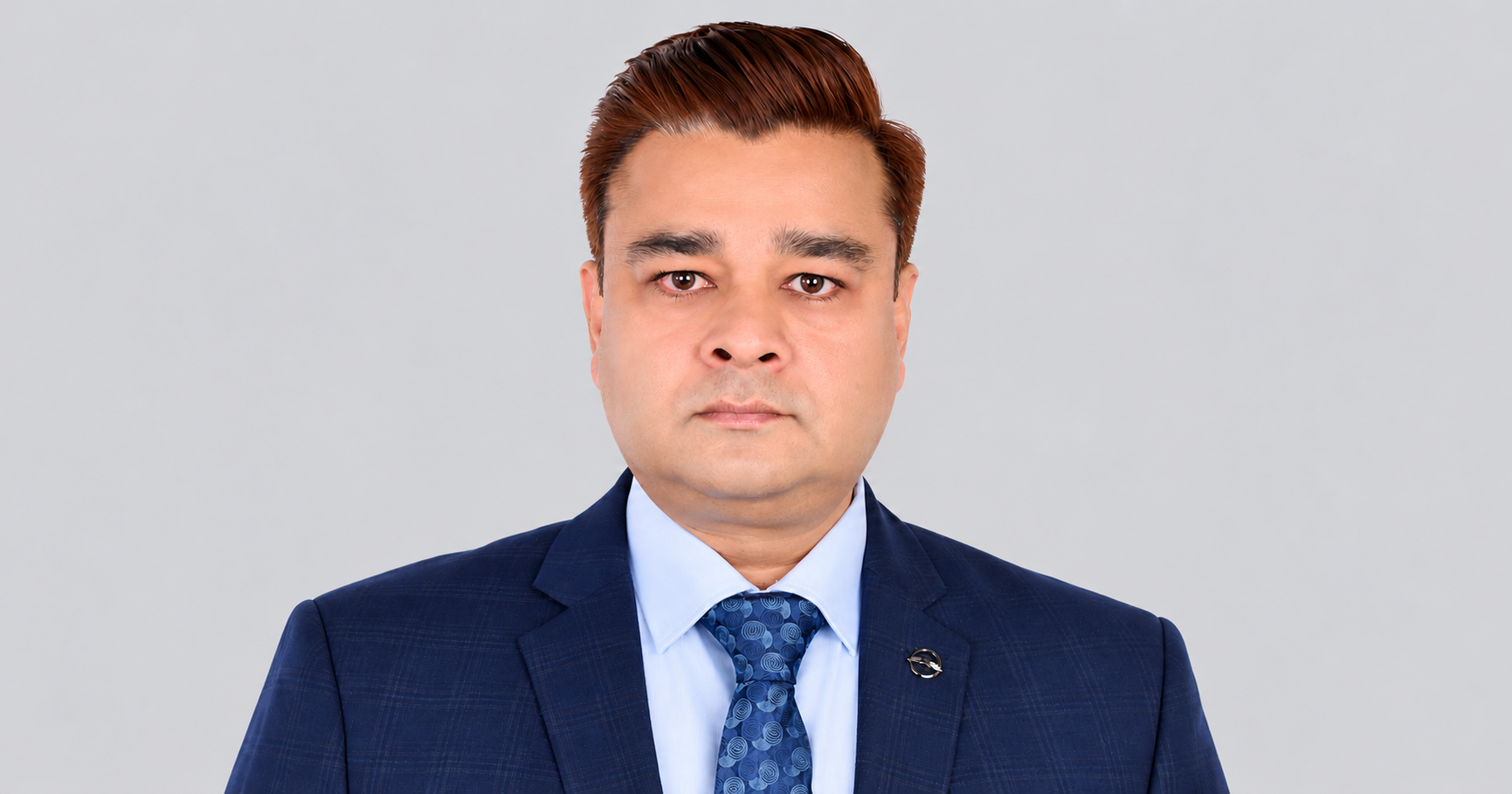
From mission-critical aviation systems to entrepreneurship in the UAE, Tushar Cairae has built his leadership philosophy around a simple test: technology matters only when it creates measurable value for the business.
For more than two decades, Tushar Cairae has worked at the point where technology strategy meets operational reality. His career has moved through aviation, banking, enterprise services and large-scale IT transformation, giving him a front-row view of why ambitious technology programs succeed - and why some lose momentum despite sound platforms, experienced teams and significant investment.
The lesson he carries forward is not that organizations need more technology. It is that transformation requires clarity about the business outcome, genuine alignment across stakeholders and the discipline to keep execution connected to what operations actually need. That perspective now sits at the center of his work as Managing Director and Founder of Horizon Hive Technology LLC in Dubai, where he is building a technology business focused on practical transformation, automation, cybersecurity, cloud, infrastructure and enterprise services.
Cairae's career has included responsibility at substantial operating scale. During more than eleven years at IndiGo, where he served as Associate Director, he managed enterprise IT across 82 domestic and 26 international locations, led a team of more than 600 people, managed an INR 300 crore budget and supported systems used by more than 50,000 end users. His subsequent leadership roles include Vice President IT at awfis and Chief Information Officer at Star Air. Across his wider career, he has worked with larger-scale technology budget portfolios and geographically fragmented environments across the globe. Those environments shaped a view of technology leadership that is less about maintaining systems and more about enabling the business to perform, adapt and grow.
Transformation Starts Before the Technology
Cairae's view of transformation was shaped by a pattern he observed repeatedly: when large programs struggle, the technology itself is often not the root problem. A platform may be capable and the architecture may be sound, but the business context can shift between an executive decision and ground-level execution. If that change is not captured quickly, the program begins solving yesterday's problem while the operation has already moved on.
For him, that makes the definition of success one of the most important early decisions in any transformation. The real question is not whether a platform reaches go-live. It is what will be different six months later: how the operation will work, what customers or employees will experience differently, and which measurable business outcomes the investment is expected to deliver.
He summarizes his leadership approach through the CID principle: Consistency, Intent and Discipline. Consistency is about keeping the transformation anchored to what is being built and why. Intent means bringing business stakeholders genuinely into the decisions and intended outcomes rather than treating communication as a periodic update. Discipline means protecting execution quality when schedules tighten and pressure grows to cut corners.
That thinking was reinforced at IndiGo. At the scale of dozens of domestic and international locations, Cairae says a small misalignment does not remain small - it multiplies across operations. His emphasis therefore moved from simply gaining agreement in meetings to creating real alignment around the objectives of a program.
"Technology creates the opportunity, operations determine how that opportunity is realized, and leadership ensures that both remain aligned with the business objective."
From Enterprise Technology Leader to Entrepreneur
After roughly 25 years in enterprise technology, Cairae reached a conclusion that became central to his move into entrepreneurship: too many senior technology leaders spend a disproportionate amount of time managing infrastructure, hardware, operations and day-to-day firefighting instead of concentrating on what technology should ultimately enable - business growth.
He believes the role of a CIO or digital leader should be judged by the value technology creates through revenue enablement, efficiency, innovation and competitive advantage. That conviction shaped Horizon Hive Technology. Rather than positioning technology as an end in itself, the company is being built around the idea that organizations need more proactive, intelligent and scalable operating environments - with automation and agentic AI used where they can reduce friction, inconsistency and avoidable human error.
The transition also reflects a broader change in how Cairae sees leadership. Running an enterprise IT function teaches a leader to manage risk, budgets, continuity and stakeholders. Building a business adds another layer: every capability, investment and commitment must also stand up commercially. In his words, technology leadership should be measured by the growth and value it creates for the business.
Turning Technology Investment into Measurable Value
Cairae's experience spans cloud transformation, ServiceNow platform governance, ERP modernization, cybersecurity frameworks, infrastructure modernization and enterprise service management. Across his leadership career, he has directed 24/7 global IT operations supporting more than 50,000 users and mission-critical systems, established a ServiceNow Center of Excellence across ITSM, ITOM, ITAM and Digital Portfolio Management, and led cost-optimization initiatives that generated multi-crore savings while improving resilience and service delivery.
He also points to work around digital employee experience, automation of call-center and IT service-desk operations, and digitization initiatives intended to reduce printing and associated environmental impact. The common thread is the same: technology investment needs a direct connection to operational performance, user experience, cost, resilience or growth.
One documented example from his IndiGo tenure shows how that philosophy translated into measurable operational value. As Associate Director and Head of End User Computing, Cairae and his team were responsible for IT infrastructure, connectivity across the airline's airport network, end-user devices and several mission-critical business applications. At the time, approximately 3,000 endpoints contained critical aviation data without a robust data-protection solution, creating a risk that device or data loss could disrupt employee productivity for hours or days.
The team evaluated multiple endpoint data-protection options with implementation partner Nubigo Technologies, beginning with a five-license proof of concept for critical users in IT, HR and finance. Following the successful pilot, the deployment expanded to 2,000 endpoints and ultimately to 3,000, before moving to the cloud version of Druva inSync. The solution introduced automated backup, self-service restore, fast search and recovery, and cloud-based protection designed to reduce recovery effort and operational disruption.
The results were concrete. The client-supplied Druva case study reports a 90% reduction in IT support calls related to data recovery, with 3,000 endpoints protected from data loss, breaches and misuse. Self-service restore also enabled employees to recover files or move to replacement devices more quickly, supporting productivity, business continuity and user confidence. For Cairae, the lesson is consistent with his broader philosophy: technology earns its place when it reduces friction, protects the operation and creates a measurable business outcome.
Security and Resilience by Design
For Cairae, cybersecurity and digital resilience should not sit at the end of a transformation as technical controls added before launch. They belong inside the business decision-making lifecycle from the beginning - in investment decisions, architecture reviews, procurement, transformation programs and continuity planning.
His approach is pragmatic rather than absolute. Eliminating every form of risk is neither realistic nor commercially sustainable. The more useful discipline is to understand the business impact of a risk, decide what must be prevented, what can be mitigated and what the organization is prepared to tolerate, and then assign ownership for the residual risk.
That becomes particularly important when a business wants to launch a cloud or AI-enabled capability quickly. Instead of allowing security to become a blocker or allowing speed to override risk, Cairae advocates bringing business, technology, security, risk and operations together. Controls such as zero-trust access, data classification, privileged-access management, monitoring, segmentation, backup and recovery, AI guardrails and incident-response procedures can then be designed into the solution. Where a control cannot be implemented immediately, he argues that the remaining risk should be documented, assigned and addressed through a time-bound remediation plan.
The principle is straightforward: secure and resilient by design. In that model, security does not compete with growth; it helps make growth sustainable.
Aviation: Where Technology Failure Becomes Visible Immediately
Few environments make the relationship between technology and operations as visible as aviation. Cairae describes aviation as a business that operates with very little buffer: if an airport system fails, the impact appears immediately in check-in queues, departure information, crew coordination and the passenger experience.
When he joined Star Air as Chief Information Officer, he says his first weeks were spent listening to operations teams, ground staff and airline leadership. The central finding was that business growth was beginning to outpace the supporting technology environment. That observation shaped the priorities that followed.
At Star Air, he describes responsibility for round-the-clock IT operations across 17 cities and 23 airports, covering the website and mobile app, cargo systems, loyalty programs, passenger service systems, SAP ERP and a network of more than 150 links. In that setting, every technology investment had to answer a practical question: what business problem does this solve? Cloud adoption, for example, was tied to deployment speed and downtime risk rather than modernization for its own sake. Endpoint compliance and data security were treated as operational necessities, not simply audit requirements.
The same operating discipline now informs the standards he brings to clients: availability, recovery, scalability, security and customer experience need to be designed together rather than managed as separate technology workstreams.
AI Beyond the Hype Cycle
Cairae is positive about the potential of AI, but cautious about the gap between market enthusiasm and enterprise readiness. In aviation, he sees credible use cases in areas such as operations and delay prediction, fuel optimization, maintenance analytics, intelligent passenger systems and automated IT service management.
His skepticism is directed not at AI itself, but at the idea that an AI layer can compensate for weak foundations. In his view, inconsistent data, poorly defined processes and teams that are not aligned around outcomes will simply produce AI outputs that cannot be trusted. Clean data, disciplined processes and a culture that uses data in decision-making may take longer to build than the technology deployment, but they determine whether the investment can scale beyond a pilot.
That distinction matters as organizations experiment with agentic AI and automation. A proof of concept can be impressive in isolation; enterprise value only appears when governance, integration, accountability, data quality and return on investment are clear enough for the capability to become part of normal operations.
"AI would not fix a data problem."
Building Horizon Hive for the UAE and GCC
Horizon Hive Technology is still in a growth phase in the UAE market, and Cairae is deliberately approaching that stage through focused delivery rather than premature scale. The company is concentrating on small and mid-sized digital engagements that allow it to build trust, credibility and long-term customer relationships while strengthening its internal capabilities.
Its market approach starts with direct engagement with CXOs and business leaders to understand pain points, operating requirements, budgets, technology priorities and expectations from transformation. The goal is to shape solutions around real business conditions rather than lead with a predetermined technology stack.
Internally, Horizon Hive has created what Cairae calls a 'Tigers Team' model. Subject-matter experts take ownership across the technology lifecycle - from lead generation and solution development through delivery and revenue realization. The incentive structure is linked to successful customer delivery and formal acceptance, reinforcing accountability for outcomes rather than activity alone.
That internal model is complemented by partnerships with vertical-specific OEMs, systems integrators and service partners, as well as support from industry mentors. Cairae identifies three principles as non-negotiable as the company scales: data security and privacy, accuracy and transparency in what the business commits to, and accountability through successful delivery and customer sign-off.
The ambition is to build a reliable technology partner for organizations across the UAE and, over time, the wider GCC - one capable of combining internal expertise, specialist partnerships and commercial accountability without losing the customer trust on which that growth depends.
The Entrepreneurial Mindset for Technology Leaders
Cairae's advice to CIOs, CTOs and technology executives considering entrepreneurship is not limited to those planning to start a company. He believes every technology leader should already think like an entrepreneur: take ownership of outcomes, create value from every investment, protect budget discipline and still make room for innovation.
That mindset also explains the phrase he has long used with his teams: 'Dream Big. Think Big. Decision Big.' Ambition, in his view, is useful only when it remains grounded in the real needs of the operation. Transformation does not become valuable because it is large, complex or fashionable. It becomes valuable when technology, operations and leadership stay aligned long enough to produce a better business outcome.
As Horizon Hive Technology grows, that is the standard Cairae is carrying from enterprise leadership into entrepreneurship: build with intent, execute with discipline and judge technology by the value it leaves behind.