
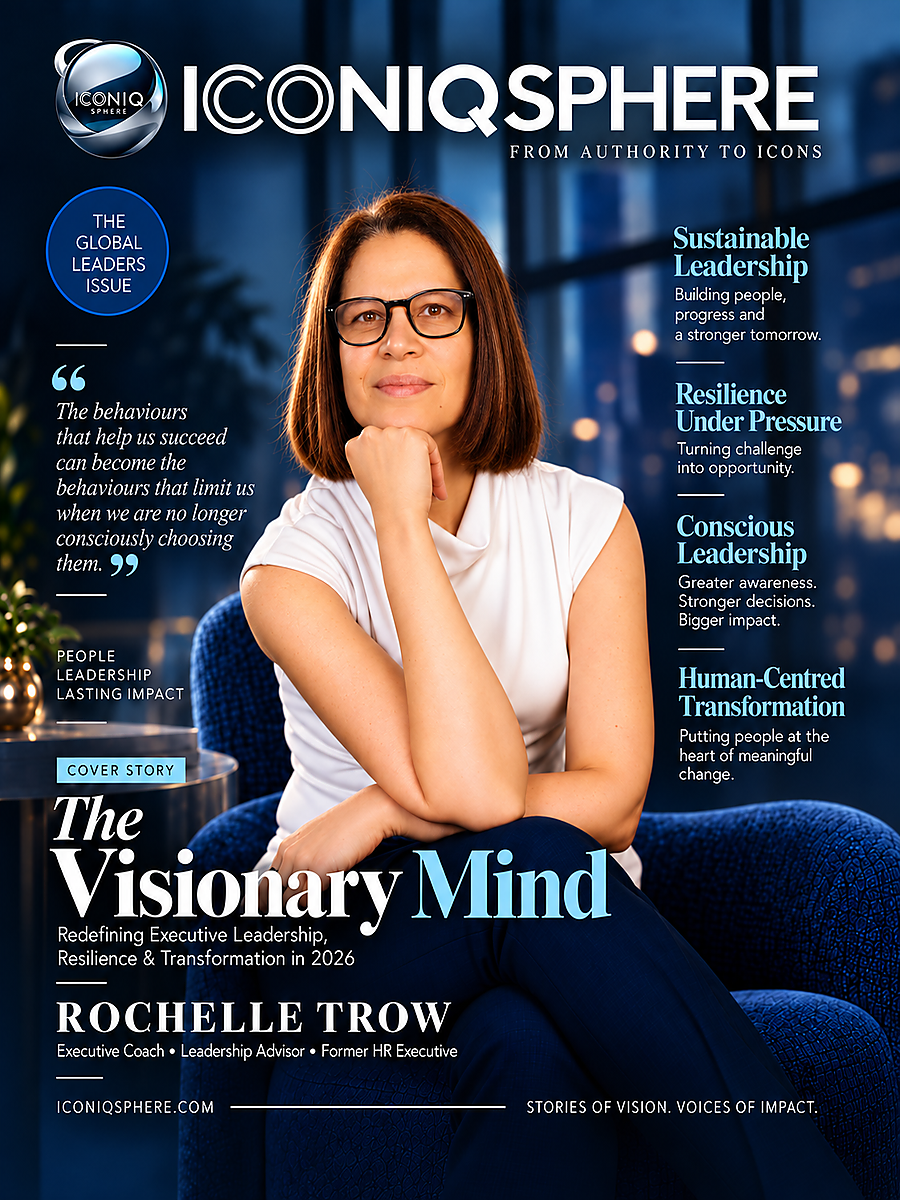
The Visionary Mind Redefining Executive Leadership, Resilience & Transformation in 2026
Rochelle Trow
Founder | Executive Coach | HR Advisor
The Visionary Mind Redefining Executive Leadership, Resilience & Transformation in 2026
Rochelle Trow explores a more sustainable approach to leadership helping executives understand the patterns behind performance, build resilience, lead with greater self-awareness, and navigate transformation without losing their sense of clarity and choice.
Rochelle Trow: Rethinking Sustainable Leadership
Many of the qualities that help leaders succeed are widely admired. Taking responsibility, working hard, staying available, striving for excellence, and pushing through challenges are often seen as signs of commitment and capability. Yet under sustained pressure, those same strengths can quietly become limitations. Behaviours that were once conscious choices can turn into automatic patterns, shaping decisions, relationships, and leadership effectiveness in ways that often go unnoticed.
This insight sits at the heart of Rochelle Trow's work. Drawing on more than twenty-five years of experience across human resources, executive leadership, coaching, organisational transformation, and personal development, she has become increasingly interested in understanding why successful people often find themselves trapped by the very behaviours that once helped them thrive. Her work asks a deceptively simple question: what happens when the behaviours that helped us succeed become so automatic that we no longer realise they are making choices for us? As organisations become faster, more complex and more demanding, she believes sustainable leadership depends not only on what leaders are capable of doing, but on whether they understand what is driving them while they do it.
Staying Grounded Under Pressure
Some of Rochelle’s most important lessons about pressure were formed long before she entered the corporate world. Growing up in South Africa during apartheid as the youngest of ten children taught her how to observe people closely, understand where power resided, and adapt to constantly changing environments. Those skills later became valuable assets as she navigated complex organisational transformations and leadership challenges.
Over time, however, she discovered that strengths can become liabilities when overused. Her ability to adapt became so ingrained that she often failed to notice how much she was changing herself in the process. Working harder, taking on more responsibility, and continually proving her worth eventually led to burnout. That experience fundamentally changed her understanding of leadership. Rochelle came to realise that functioning under pressure and leading effectively under pressure are not the same thing. She had spent years becoming very good at reading the room, but had not learnt to read herself with the same level of attention. That experience changed how she thinks about leadership under pressure: the question is not simply how much a leader can carry, but whether they remain grounded enough to recognise what is happening in themselves and consciously choose how they respond.
The Human Story Beneath Every Organisation
Having worked across industries ranging from pharmaceuticals and manufacturing to consumer health and semiconductors, Rochelle has observed a common thread beneath every organisational structure: people bring their personal histories into the workplace. Individual beliefs about achievement, belonging, security, and success often shape behaviour far more than organisational charts or corporate strategies.
She believes organisations and individuals constantly influence one another. A person driven by the need to prove themselves may find their behaviour reinforced by a culture that rewards relentless effort, while someone whose sense of value comes from being needed may struggle to delegate. What interests her is the interaction between what people bring into an organisation and what the organisation then reinforces in them. For her, sustainable success requires understanding not only what an organisation expects, but also what internal beliefs are shaping how individuals respond to those expectations.
When Success Stops Serving Us
One of Rochelle’s most significant insights is that the behaviours driving professional success can also create personal disconnection. For many years, achievement provided a sense of security, belonging, and validation. Because those behaviours generated positive results, neither she nor those around her had much reason to question what was driving them.
She now believes that high performance can emerge from very different places. Two leaders may appear equally successful, yet one may be energised by the work and consciously choosing the effort, while the other may be driven by fear of failure, disappointing people or no longer being seen as valuable. Over time, people can become so identified with their professional achievements that they lose sight of who they are beyond their performance. Rochelle’s own journey eventually led her to question long-held assumptions about success and inspired much of the thinking behind Awakening to Wholeness. Today, she views presence as the ability to remain connected to oneself while navigating external demands and expectations.
Through her work as an executive coach and former HR executive, Rochelle has learned that coping often disguises itself as competence. Highly capable individuals rarely stop performing when pressure increases. Instead, they typically double down on the very behaviours that made them successful in the first place. The dependable leader becomes constantly available, the perfectionist becomes more controlling, and the problem-solver assumes responsibility for everyone else's challenges.
For Rochelle, one of the clearest signs that someone is coping rather than thriving is the gradual loss of choice. People continue working late, overcommitting, or holding onto control not because they consciously choose to, but because they no longer know how to respond differently. Thriving, she believes, is not about avoiding pressure. The difference is whether people still have some agency over how they respond to pressure - whether they can step back, change pace, say no when something genuinely is not a priority or allow somebody else to do something differently.
Rochelle argues that organisations have misunderstood resilience for decades by equating it with endurance. Too often, people push themselves relentlessly until a holiday or break becomes their only opportunity for recovery. For her, resilience has to include restoration during everyday working life, rather than relying on occasional breaks to recover from months of sustained pressure.
She advocates a broader view of resilience that includes both individual and organisational responsibility. Leaders must examine workloads, meeting cultures, and expectations around availability, while individuals need to understand their own warning signs and recovery practices. Rochelle describes this balance as "micro restoration and macro restoration"- small daily habits that prevent depletion combined with meaningful periods of genuine disconnection and renewal. A holiday, she argues, should not become emergency recovery from the way someone has been working for the previous six months.
Creating Space Between Trigger and Response
One of Rochelle’s most practical contributions to leadership development is her Notice → Anchor → Choose → Return philosophy. Rather than offering another leadership framework or checklist, the model helps individuals become more conscious of what is driving their reactions in the moment.
The process begins with noticing automatic responses and recognising long-established behavioural patterns such as people-pleasing, control, avoidance, or restlessness. Anchoring means coming back to what someone already knows about themselves and how they want to respond. Choosing is the moment when a conscious response replaces an automatic one, while returning acknowledges that setbacks are inevitable and growth comes through repeated practice rather than perfection.
For Rochelle, lasting behavioural change requires understanding the beliefs beneath the behaviour itself. Many leadership habits develop long before an individual enters the workplace and often serve important purposes. By increasing awareness and practising small alternative responses, leaders can gradually create healthier patterns that support both performance and personal wellbeing. The goal is not perfection but greater freedom to respond intentionally rather than allowing old habits to make decisions on their behalf.
Once leaders begin recognising their automatic reactions, they often encounter a deeper challenge: understanding why certain behaviours continue even when they no longer serve them.
Why Boundaries Are Harder Than They Appear
Rochelle believes that understanding the importance of boundaries and consistently maintaining them are two very different challenges. In her experience, most successful executives already know they should delegate more, disconnect more often, and occasionally say no. The real difficulty emerges when those boundaries are tested in real-world situations.
She explains that the struggle often stems from deeper beliefs and identity patterns. Leaders who have built their reputation around being dependable may feel that saying no is equivalent to letting others down. Those who derive a sense of value from being needed can find delegation uncomfortable, while high achievers may view allowing others to approach tasks differently as a compromise of standards. These responses are frequently unconscious, having been reinforced over many years of professional success.
For Rochelle, effective boundaries are not about rigidly refusing requests or withdrawing from responsibility. Instead, they involve understanding what happens internally when demands increase and becoming conscious of the patterns that cause boundaries to disappear under pressure. She views boundaries less as a time-management technique and more as an exercise in clarity, self-awareness, and the confidence to remain accountable without assuming responsibility for everything.
Beneath many struggles with boundaries lies another powerful force that often operates quietly in the background: fear.
The Quiet Influence of Fear in Leadership
Rochelle observes that one of the greatest challenges for senior leaders is acknowledging that fear exists at all. Corporate environments often reward confidence, certainty, and composure, making it difficult for leaders to admit concerns about credibility, disagreement, or professional risk.
According to Rochelle, fear frequently disguises itself as more socially acceptable reasoning. Leaders may describe their actions as being pragmatic, strategic, or politically aware when, in reality, concerns about belonging, approval, or reputation are influencing their choices. She encourages leaders to view fear as information rather than something to suppress or avoid. Sometimes fear is telling us something important about the environment or the power dynamics around us; at other times it may be protecting our own need for belonging, approval or credibility. Understanding the difference matters.
One of the clearest indicators she has observed is the difference between conversations that occur inside meetings and those that happen afterward. When leaders consistently express their true opinions only after decisions have been made, it may signal that fear is influencing their willingness to contribute when it matters. Rochelle believes the objective is not to become fearless but to understand fear well enough to listen to what it is telling us without automatically allowing it to make the decision for us.
Leading Humanly in an Accelerating World
As organisations embrace artificial intelligence, restructuring, and increasingly complex operating environments, Rochelle believes the human side of leadership must evolve alongside technological progress. While organisations have become highly effective at introducing new systems, improving efficiency, and redesigning structures, she argues that investment in human capacity has not kept pace.
She suggests that leadership development can no longer focus solely on skills, competencies, and technical capability. Future leaders will need stronger judgement, self-awareness, discernment, and the ability to navigate uncertainty. They must know when speed is beneficial and when it undermines thoughtful decision-making, when technology provides the answer and when a human conversation is still essential.
Rochelle also believes that self-aware leaders are often more effective commercially because they are less driven by the need to prove themselves. They are more open to challenge, more willing to change their minds, and better equipped to create environments where people feel safe contributing honest perspectives. However, she cautions against placing the entire responsibility on individuals.
Human capacity has limits. Organisations cannot continually add workload, technology, restructuring, new priorities and complexity and expect individual resilience or self-awareness to absorb the impact. The future of leadership therefore requires both developing human capacity and designing organisations with greater awareness of its limits.
The Missing Element in Organisational Transformation
Drawing on more than 25 years of experience across transformations, mergers, acquisitions, divestments, and organisational redesigns, Rochelle believes that many organisations make the mistake of assuming people change as quickly as structures do. While reporting lines, systems, and operating models can be altered relatively quickly, human understanding, trust, and behavioural change often take much longer to develop.
She views transformation as two parallel journeys: the visible structural transformation and the less visible human transition. While organisations tend to focus on measurable milestones such as cost savings, leadership appointments, and process changes, employees are often trying to understand how the transformation affects their own roles, influence, relationships, and future within the organisation.
Rochelle emphasises that trust cannot be created through communication plans alone. Employees evaluate change through their lived experiences, comparing leadership promises with actual behaviour. Organisations that successfully navigate transformation are typically those that demonstrate consistency, acknowledge uncertainty honestly, and create opportunities for people to make sense of change rather than simply receive information about it. Implementing a new structure may complete the project plan, but it does not necessarily mean the transformation has landed. The real test is whether people understand what has changed, whether trust has been sustained or rebuilt, and whether the behaviours needed for the new organisation are actually beginning to emerge.
Leading Beyond Automatic Patterns
Throughout her work, Rochelle has returned to a simple but powerful observation: many of the patterns that help people succeed are not inherently problematic. They become limiting only when they operate outside conscious awareness. Whether leading teams, navigating change, or responding to pressure, sustainable leadership begins with the ability to notice those patterns, understand what drives them, and choose how to respond.
But that responsibility cannot sit with the individual leader alone. As organisations become faster, more technologically capable and more complex, they also need to become more conscious of the human capacity required to sustain that pace. The challenge ahead is not simply to build leaders who can endure more, but to create organisations in which people can continue to perform, adapt and make good decisions without losing themselves in the process.