
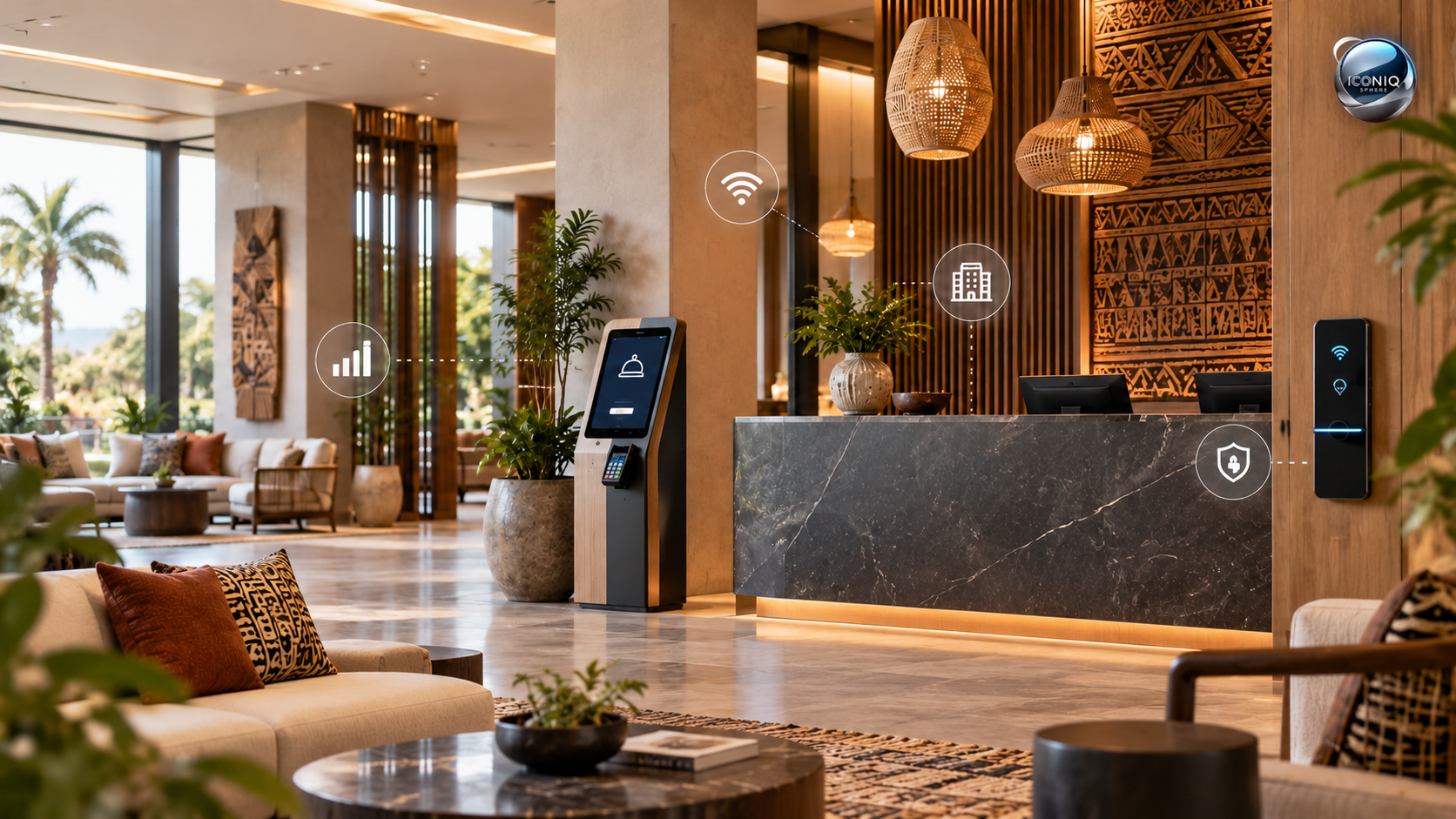
Africa's hotel pipeline usually gets discussed in terms of rooms, brands and destination growth. Those numbers matter, but they don't tell the whole story by themselves.
A new hotel can have a compelling concept, a strong operator, and a genuinely promising market behind it. Yet its long-term performance will increasingly hinge on something far less visible: the technology infrastructure quietly built beneath the guest experience, the part nobody photographs for the brochure.
This was never simply about picking a property management system, installing fast Wi-Fi, or bolting on a guest app at the last minute. It's about designing hotels that can operate reliably, protect revenue, serve guests consistently, and adapt as the technology around them keeps changing. Across the African hospitality markets I work in, I see a clear opening here. Plenty of developments are being planned right as guest expectations climb, operators grow more data driven, and owners push for greater operational visibility than ever before. The hotels that treat technology as a core development decision, not a late stage purchase tacked on near opening day, will be in a far stronger position to compete.
Start With the Operating Reality on the Ground
Technology decisions sometimes get made by looking at what works in a flagship hotel in London, Dubai or Singapore and assuming it will simply transplant elsewhere. The trouble is, a solution that thrives in one market doesn't always survive the trip to another.
African hospitality was never a single market to begin with. Conditions vary enormously between countries, between cities, and even between neighbourhoods inside the same city. Power reliability, internet connectivity, payment preferences, supply chains, local skills and regulatory requirements all shape what technology can realistically deliver on the ground, whatever the sales brochure promises.
A hotel sitting in a major business district might enjoy strong fibre connections, several telecoms providers to choose from, and experienced technical support just a phone call away. A resort, lodge or remote destination can face a completely different operating reality. There, keeping the power on, maintaining backup connectivity, and being able to run essential systems offline may matter far more than any flashy guest-facing feature.
The right question was never "what's the newest technology available." It's "what technology will actually work, consistently, for this hotel, this team, and these guests." That distinction carries far more weight than it first appears.
Build the Foundations Before Chasing the Features
The most valuable technology in a hotel is often the technology guests never even notice, right up until the moment it fails and everyone notices at once.
Reliable power, structured cabling, network coverage, cybersecurity, backup systems and proper equipment space rarely make it into the exciting slides of a development presentation. But they quietly determine whether everything built on top of them actually works. If connectivity is weak, cloud based hotel systems become unreliable exactly when they're needed most. If Wi-Fi coverage is patchy, the guest experience suffers and staff waste their day working around the gap instead of serving guests. If systems get installed without clear integration between them, teams get stuck doing manual processes and re-entering the same data twice. If there's no resilience plan sitting in a drawer somewhere, a single outage can ripple through reservations, payments, guest communication and daily operations all at once.
For developers and owners, this means technology needs a seat at the table early, right alongside building services, security, room design and operational planning, not squeezed in once construction is nearly finished, when every change suddenly costs three times as much. A practical technology plan should be able to answer a handful of basic questions from day one: Which services absolutely must keep running during a power or connectivity interruption? Which systems need to talk to each other, and which don't? Where will network equipment, servers and support infrastructure actually live inside the building? How will coverage hold up across guest rooms, public areas, meeting spaces and back of house operations? And who will actually support these systems once the doors open and the marketing team has moved on to the next project?
These were never purely IT questions to begin with. They're business continuity questions, and guest experience questions, wearing an IT disguise.
Integration Beats a Long Shopping List Every Time
Hotels today can choose from an enormous menu of systems: property management, point of sale, revenue management, customer relationship management, digital payments, guest messaging, energy management, workforce scheduling, and plenty more beyond that.
The goal was never to collect as many platforms as possible, like trophies on a shelf. It's to build a simple, genuinely connected operating environment. A property management system might sit at the operational heart of a hotel, but it can't deliver its full value if it's cut off from payments, distribution, restaurant operations, accounting or guest communications. When systems refuse to talk to each other, employees end up doing that integration by hand instead, and that's exactly where errors creep in, service slows down, and management reporting loses its reliability.
The best technology strategy isn't necessarily the most ambitious one on paper. It's the one that supports the hotel's actual priorities with the fewest unnecessary complications tangled underneath. For a limited service city hotel, that might mean frictionless booking, efficient check-in, dependable payments and tight revenue controls. For a resort, guest communication, staff mobility, energy management and operational coordination may take priority instead. For a mixed use development, the ability to connect hotel, retail, events and residential functions under one coherent system may matter more than any single feature. Technology should follow the business model. It was never supposed to be the other way around.
Design for People, Not Just for Systems
A hotel's technology is only ever as effective as the people actually using it day to day. This is exactly where plenty of projects quietly lose their value.
A system can look genuinely impressive during a vendor presentation, but if it's difficult to use, poorly configured, or left unsupported once the hotel opens, staff will find workarounds within weeks. The hotel then carries the full cost of the technology without ever receiving the benefits it was bought for in the first place.
Successful implementation means bringing operational teams into the conversation early. Front office, housekeeping, finance, food and beverage, sales, engineering and security all see the hotel from a different angle, and their input tends to surface practical issues nobody in a boardroom would have spotted. Training deserves the same ongoing attention, rather than treating it as a single session before opening day and calling it done. Hotels experience staff turnover, systems evolve, and operating routines shift over time. A genuinely useful technology plan includes clear ownership, straightforward training materials, and access to dependable support long after launch week fades into memory.
The goal was never to turn every hotel employee into a technology specialist. It's to hand people tools that actually make their work easier, freeing up more of their time to spend with guests instead of wrestling with a screen.
Let Data Lead to Better Decisions, Not Just Bigger Reports
One of the strongest reasons to invest in connected hotel technology is simply the ability to make better decisions with it. When information sits scattered across disconnected systems, or worse, still lives in spreadsheets and paper records tucked in a filing cabinet, leaders lose a clear view of performance. It becomes far harder to understand guest behaviour, spot revenue opportunities, control costs, or respond quickly when something starts going sideways operationally.
Well designed systems can give owners and operators sharper visibility into occupancy patterns, booking channels, guest preferences, energy consumption, labour needs and commercial performance. But data only earns its value when it's accurate, accessible and actually connected to real decisions, rather than sitting in a report nobody reads.
Hotels don't need to chase every available metric under the sun. They need a small handful of meaningful indicators that genuinely help teams improve. Where exactly is revenue leaking out? Which guest complaints keep showing up again and again? Which spaces are quietly burning more energy than expected? Which booking channels actually turn a profit once the fees are accounted for? The next generation of successful hotels across Africa won't simply collect more data than their competitors. They'll use the data they have far more intelligently.
Prepare for AI, But Don't Start There
Artificial intelligence is steadily working its way into the hospitality conversation, from personalised guest communication to forecasting, revenue optimisation and service support. It carries genuine potential, particularly for speeding things up and cutting down repetitive work nobody enjoys doing anyway.
That said, AI cannot make up for weak foundations underneath it. If a hotel's core data is incomplete, its systems are disconnected, or its teams aren't yet comfortable using the tools already in front of them, bolting on AI will simply create more complexity than value. The priority should always be reliable operations, clean data, and systems that genuinely work together first. Once those fundamentals are solidly in place, AI can become a practical addition rather than a fashionable experiment that fizzles out within a year. The same principle holds for every emerging technology that comes along next. Start with the actual problem that needs solving, then go find the tool built to solve it, not the other way around.
A Strategic Opportunity for Developers and Investors
For developers, technology infrastructure deserves to be viewed as part of asset protection, not a line item to trim when budgets get tight. For operators, it's a genuine route to consistency and efficiency across every property in a portfolio. For investors, it can strengthen a hotel's ability to adapt, protect revenue, and stay competitive over the years a building actually has to earn its keep.
Africa's hospitality growth story was never only about building more hotels. It's about building hotels that are more resilient, better connected, and genuinely more responsive to the realities of the markets they sit in. The projects that stand out will likely be the ones that pair strong design and service with practical technology planning from the very earliest stages, not as an afterthought bolted on near the ribbon cutting. They'll create guest experiences that feel effortless, support their teams with tools worth using, and give owners a far clearer picture of how their assets are actually performing.
Technology should never be an afterthought added onto a finished building. It should be part of the thinking that shapes the hotel from the very beginning. That, in the end, is the real infrastructure behind the next generation of African hospitality.